How can Sub-Saharan Africa improve food security while protecting biodiversity and reducing greenhouse gas emissions?
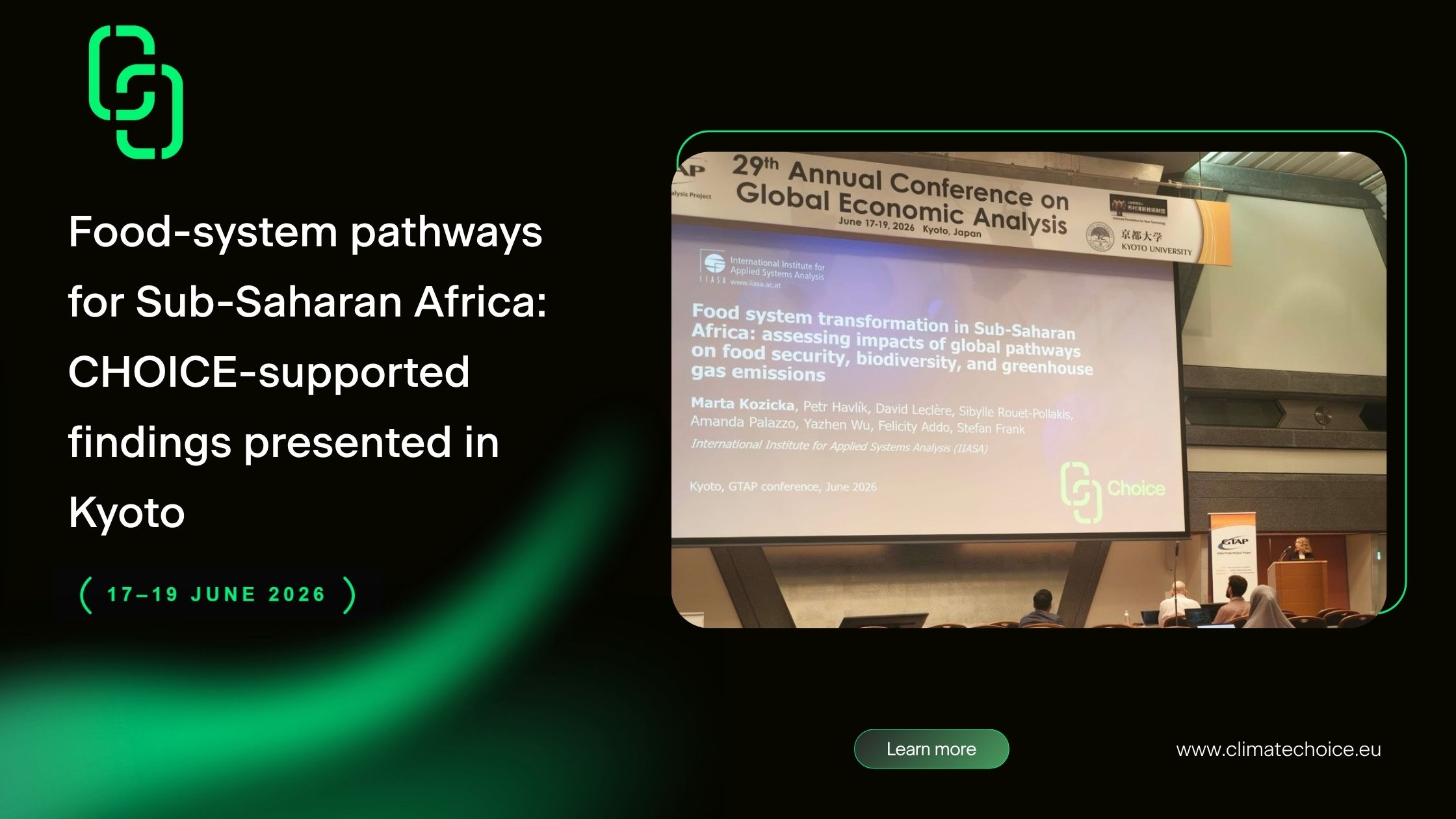
This question was at the centre of a presentation delivered by Marta Kozicka from the International Institute for Applied Systems Analysis (IIASA) at the 29th Annual Conference on Global Economic Analysis in Kyoto, Japan.
Held from 17 to 19 June 2026 under the theme “Confronting Developmental and Environmental Challenges in Asia and the New Trade Landscape,” the conference brought together experts working on quantitative approaches to global economic, environmental and trade-related challenges.
Why Sub-Saharan Africa needs a different perspective
Sub-Saharan Africa is expected to experience rapid population and income growth, increasing demand for food and placing new pressure on production, trade and land use. Yet the region starts from a different position than many high-income parts of the world: consumption of animal-source foods remains comparatively low, while the region is a structural net food importer exposed to global market risks.
The region is also highly diverse. A pathway that produces positive results in South Africa may have very different effects in Eastern Africa, the Congo Basin or Western Africa.
What does dietary change mean in this study?
The dietary scenario follows the EAT–Lancet Planetary Health Diet, a global reference diet designed to support human health while reducing pressure on the environment.
However, moving towards the Planetary Health Diet does not mean the same change everywhere. In many high-income countries, it usually involves reducing meat and other animal-source foods. In most Sub-Saharan African subregions, current consumption is already very low. The modelled transition therefore includes increased consumption of animal-source foods, alongside a more balanced diet. South Africa is the only subregion where animal-source food consumption declines under this pathway.
This difference is crucial: food-system transformation must improve diet quality and tackle undernutrition, not simply apply the same dietary message across every region.
More food, but greater pressure on nature
Using the GLOBIOM land-use model, the study compared pathways up to 2050, including higher agricultural productivity, reduced food loss and waste, dietary change and a bundled scenario combining these measures.
Under Business as Usual, per-capita calorie consumption increases by 34% by 2050. However, this improvement comes with considerable environmental pressure: cropland expands by 44%, modelled greenhouse gas emissions rise by 37%, and the Biodiversity Intactness Index declines by 3.3%.
These pressures are concentrated in the Congo Basin and across West Africa, the Sahel and the Horn, where globally important ecosystems are located.
Dietary change helps, but affordability matters
Dietary change delivers the strongest environmental improvements among the pathways studied, reducing pressure on land, biodiversity and greenhouse gas emissions. But it also creates important economic trade-offs.
Under dietary change alone, agricultural net imports rise to around seven times the Business-as-Usual level, domestic production falls, and food prices increase by approximately 28% compared with 2020.
The message is clear: a healthier and greener food system must also remain affordable and accessible.
Combining measures supports a more manageable transition
Combining dietary change with improved agricultural productivity and reduced food loss and waste helps ease these economic pressures.
In the bundled pathway, the projected increase in agricultural net imports is moderated from around seven times to approximately 5.4 times the Business-as-Usual level. The food-price increase also falls from 28% to 11%.
The additional measures do not deliver further greenhouse gas reductions in the model: both the dietary and bundled pathways achieve a 41% reduction compared with Business as Usual. Their main value lies in moderating imports, food prices and agricultural input use.
One region, different outcomes
The findings vary sharply across Sub-Saharan Africa.
South Africa is the only subregion not exposed to the livestock-import and price surge associated with dietary transition. It is also the only subregion where dietary change produces a positive shift in the biodiversity trajectory.
Western Africa and South Africa remain net crop exporters under most scenarios, pointing to opportunities for stronger intra-regional trade.
Eastern Africa, by contrast, faces the deepest import dependency and the highest price increases under the dietary and bundled pathways. Demand outpaces production under every scenario, while agricultural and land-use emissions continue to rise.
Together with the Congo Basin, Eastern Africa emerges as a priority region for additional environmental policies and stronger social safety nets.
Connecting research with the CHOICE South African pilot
The dietary shifts assessed in this modelling work were inspired by the CHOICE South African pilot, led by the University of Pretoria. The pilot focuses on healthier, more sustainable diets and food-waste reduction through locally relevant recommendations, digital engagement and EAT–Lancet-inspired guidance.
The analysis is also closely linked to the recently submitted CHOICE Deliverable D5.2, “Report on the greenhouse gas mitigation potential from food system interventions,” which examines the direct and indirect contribution of CHOICE interventions to greenhouse gas mitigation.
This connection between modelling and real-world engagement is central to CHOICE. While the research assesses how dietary shifts and other interventions could affect emissions, prices, trade and biodiversity, the South African pilot explores how healthier and more sustainable food choices can be encouraged in a locally relevant context.
The findings underline that no single pathway will affect every region in the same way. Global climate ambition must therefore be matched with region-specific solutions that reduce environmental pressures, support secure and affordable food systems, and respond to local dietary needs.
Want to dive deeper? Explore the full presentation here.