The CHOICE project aims to support the transition toward more sustainable food and land-use systems by strengthening the integration of climate mitigation, biodiversity protection, and health considerations into national decision-making. A key component of this effort is the use of modelling tools that can translate policy and behavioural changes into measurable impacts on land use, food production, and environmental outcomes.
Within CHOICE, the FABLE Calculator (FABLE-C) plays a central role in supporting scenario development and stakeholder engagement. The model allows researchers and policymakers to explore how changes in diets, agricultural practices, and consumer behaviour may affect food demand, land use, greenhouse gas emissions, and biodiversity over time. By providing a transparent and adaptable modelling framework, the FABLE-C helps bridge the gap between scientific analysis and policy design.
In CHOICE, the FABLE-C is being further developed and adapted to better reflect behavioural change, climate impacts, and sustainability co-benefits. These developments are being tested in pilot countries, including Spain and South Africa, where new scenarios are co-created with stakeholders to assess how targeted interventions may influence food systems and environmental outcomes.
What is the FABLE-C
The FABLE-C is an open and free Excel-based accounting tool used to study the potential evolution of food and land-use systems from 2000 to 2050. It focuses on agriculture as the main driver of land-use change and tests the impact of different policies and changes in the drivers of these systems through the combination of many scenarios. It includes 88 raw and processed agricultural products from the crop and livestock sectors and relies extensively on the FAOSTAT (2023) database for input data.
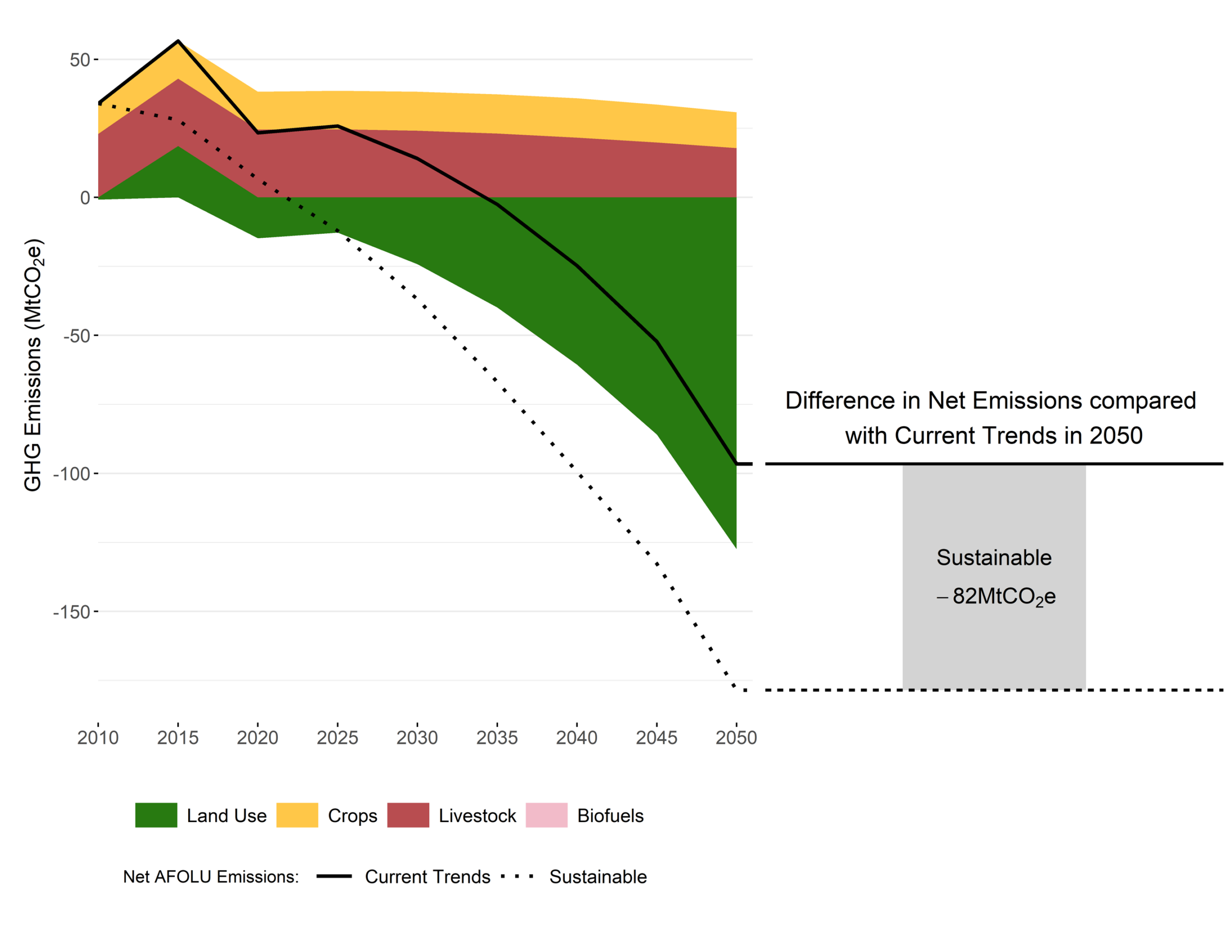
For every 5-year time step over the period 2000-2050, the FABLE-C computes the level of agricultural activity, land use change, food consumption, trade, greenhouse gas (GHG) emissions, water use, and biodiversity conservation according to selected scenarios. It has been used to compare pathways where interventions are being applied compared to the Business-as-usual trends (Figure 1). It is also used to assess whether we are getting closer to achieving global and local targets when implementing a set of interventions.
Figure 1: Projected AFOLU emissions and removals between 2010 and 2050 by main sources and sinks for the Current Trends Pathway in South Africa Source: FABLE. (2020). Pathways to Sustainable Land-Use and Food Systems. South Africa chapter
What is new in CHOICE
Within the CHOICE project, the FABLE-C is being extended to better capture behavioural change and sustainability co-benefits in national food systems. FABLE-C for Spain and South Africa have been improved and are available openly on Zenodo. These developments focus on improving the representation of consumers, agricultural practices, and climate impacts, and on making the model outputs more relevant for policy and stakeholder engagement.
Heterogeneous consumers - South Africa
The FABLE-C has been adapted to better represent differences in food consumption across population groups. In the standard version of the model, food demand is typically represented using an average consumer. In South Africa, this assumption has been relaxed by introducing a heterogeneous-consumer framework that distinguishes the youth population from the rest of the population.
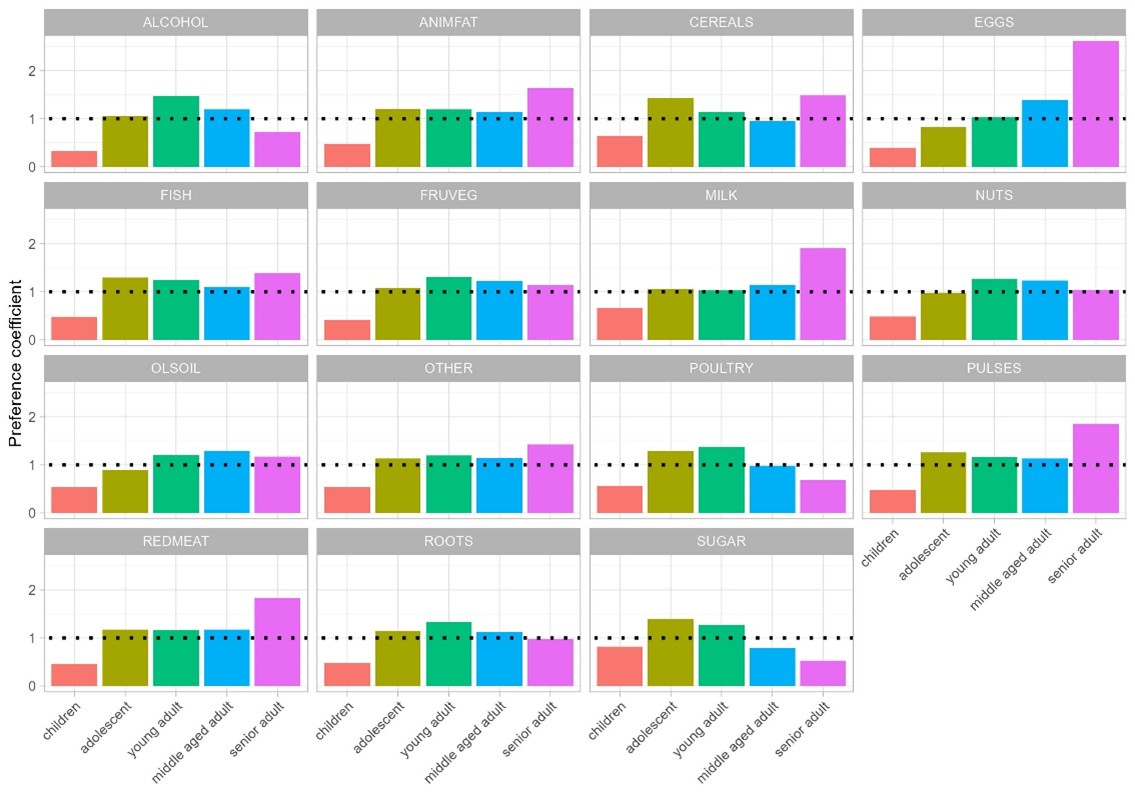
This development is based on coefficient of preferences estimated by IIASA partners to improve consumer representation in the GLOBIOM IAM. Separate demand profiles were defined for different age and sex groups (Figure 2), allowing the model to reflect how demographic structure and behavioural differences influence food demand and associated environmental outcomes.
Figure 2: Preference coefficients per age-group across food groups in South Africa
By explicitly representing consumer heterogeneity, the model can be used to assess the potential impact of targeted behavioural interventions, such as campaigns to reduce food waste or promote healthier diets. This strengthens the link between consumer behaviour, health outcomes, and greenhouse gas emissions within national food system scenarios.
Climate-sensitive agricultural production - Spain
The FABLE-C already includes climate change yield shifters that allow agricultural productivity to respond to different climate scenarios. However, in the standard dataset used in the model, these climate-sensitive yield adjustments were not available for all crops relevant to the Spanish agricultural system. Olive production, which represents a major share of agricultural land use and economic activity in Spain, was not explicitly represented with climate-sensitive yield data.
Within the CHOICE project, this gap has been addressed by integrating climate projections for olive production developed by project partners National Observatory of Athens (NOA). These projections provide information on how climate conditions may affect olive yields under different climate scenarios. The new data are used to define yield trajectories that are consistent with the existing climate change structure in the FABLE-C, ensuring that this key crop responds to climate variability.
The integration of climate-sensitive yield data for olives strengthens the relevance of the model for national decision-making. It allows users to assess how climate change may affect production in a crop that is central to the Spanish food and land-use system and to explore how changes in productivity may influence land-use dynamics, greenhouse gas emissions, and the availability of land for biodiversity.
Spatial downscaling module
Another key development in CHOICE is the integration of a spatial downscaling module that translates national land-use transitions from the FABLE-C into spatially explicit land-use change maps. While the model provides projections of total land-use change at the national level, many environmental impacts depend on where these changes occur.
The downscaling module allocates national land-use transitions across a spatial grid using historical land-use change data and spatial information such as accessibility, terrain, and protected areas. This allows the model to identify locations where land-use change is more likely to occur while ensuring consistency with national totals.
The resulting spatial projections can be used to compute more refined indicators related to greenhouse gas emissions, biodiversity, and land-use planning. In the CHOICE project, this spatial component plays an important role in connecting national modelling results with biodiversity and climate-related objectives and in supporting more locally relevant policy discussions.
What’s Next
In South Africa, the model will continue to be used to assess the impact of behavioural interventions targeting food consumption and food waste among young consumers. These analyses will support the design of awareness campaigns and policy measures aimed at promoting healthier and more sustainable diets.
In parallel, the outputs of the model are integrated into visualization tools, including the FABLE Interactive Simulation Environment (ISE), to make results more accessible to non-technical users and support stakeholder engagement.
These developments will strengthen the role of the model as a decision-support tool for exploring sustainable food system transitions.
Key Takeaways
The FABLE-C is a central modelling tool used in the CHOICE project to analyse food and land-use pathways and their environmental impacts.
In CHOICE, the model has been enhanced to better represent behavioural change, climate impacts, and sustainability co-benefits in national food systems.
New versions of the model for Spain and South Africa are operational and publicly available, supporting transparency and collaboration.
The integration of spatial downscaling and visualization tools will further improve the usability of model results for policy analysis and stakeholder engagement.
Overall, the work carried out in CHOICE demonstrates how modelling tools can support the design of more sustainable food and land-use systems by linking national scenarios with environmental and societal outcomes.


Leave a Reply