
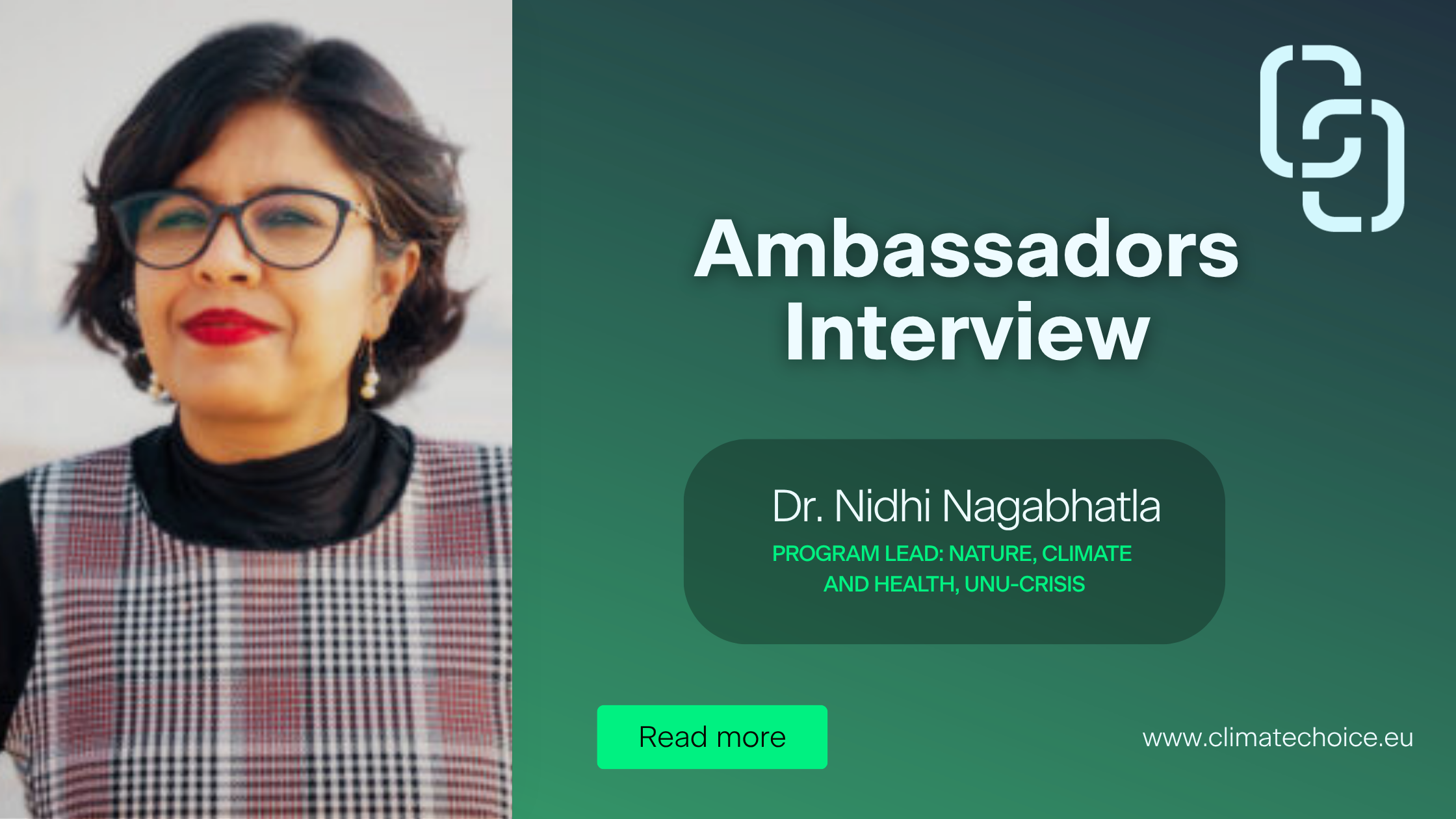
Ambassador Interview Series – Dr. Nidhi Nagabhatla
In a time when climate change, food security, and public health are increasingly intertwined, understanding the connections between people, planet, and everyday choices has never been more important. The CHOICE project works to better understand this complexity by bringing behavioural insights into climate and food system modelling and decision-making—empowering more sustainable, informed choices for a resilient future.
In this context, Dr. Nidhi Nagabhatla shares her perspective at the intersection of nature, climate, and human well-being. Drawing on extensive international experience, she explores how food systems both shape and are shaped by environmental change, and why integrating human behaviour, local knowledge, and systemic thinking is essential for building long-term resilience.
From global policy to daily habits, this conversation highlights a central message: sustainable futures are not only designed—they are chosen, one decision at a time.
1. Your work focuses on the intersection of nature, climate and health. From your perspective, how are food systems, environmental sustainability and human well-being interconnected today?
My work bridges the data, information, and knowledge gaps, pivoting toward systemic resilience, access to water, food, energy, and healthy systems (nexus). Today, our food systems are the primary drivers of environmental change, yet they are also the most vulnerable to the climate instability they help create. This means we need to move beyond simple metrics of success and focus on long-term security within this nexus. For example, by investing in nature-based solutions—such as regenerative agriculture and protecting carbon-rich peatlands—we can simultaneously stabilize the climate, secure the food supply, and safeguard public health. In today’s globalized world, the health of the planet is the ultimate determinant of a person’s health; we cannot have one without the other. Strategically, we must recognize that human well-being is a core indicator of environmental health and the planetary-level resilience agenda. The rise in zoonotic diseases, the spread of water-borne illnesses, and the growing phenomenon of climate-induced migration are all symptoms of a broken nexus. When food and water security fail, the resulting human displacement creates a wave of public health and security challenges. To this point, environmental sustainability serves as the foundational “life-support system” for human well-being-focused goals and targets. When we degrade land or mismanage water resources, we aren’t just losing biodiversity—we are dismantling the infrastructure that ensures food security. For instance, the loss of wetlands or the contamination of transboundary water systems directly compromises the nutritional quality and availability of crops. This creates a fragility loop: climate-stressed environments produce less food, leading to malnutrition and health crises, which, in turn, reduce communities’ socioeconomic resilience, making them even more vulnerable to the next climate shock. Therefore, it is very important to acknowledge, understand, and integrate the interconnections among food systems, environmental sustainability, and human well-being, as these are no longer linear; they form a circular, highly sensitive nexus, and any disruption in one domain triggers a cascading failure in the others.
2. CHOICE aims to better integrate behavioural change into climate and food system modelling. Do you think understanding people’s everyday choices is essential for designing effective climate and sustainability policies?
For years, environmental management and climate action have been a world of hard numbers: gigatonnes of carbon, parts per million, and degrees of warming. But there is a missing variable in these complex equations that is perhaps more powerful than any industrial emission—the human heart. The CHOICE initiative is now betting that the secret to saving the planet lies not just in changing our technology, but in understanding our behavior.We live in an era where most people agree that the planet is in trouble, yet daily habits remain stubbornly unchanged. Behavioral science calls this the “Intention-Action Gap.” We want to save the oceans, yet we reach for the plastic-wrapped convenience of a supermarket meal. By integrating behavioral modeling into food and climate systems, we can move beyond “preaching” sustainability and start “designing” it. Effective policy must recognize that humans are not always the “rational actors” that traditional economics assumes they are. We are influenced by social norms, immediate convenience, and the “nudge” of our environments. When we understand why a citizen chooses a high-carbon diet over a sustainable one, we can build policies that make the green choice the easiest and most instinctive one.
The best examples of behavioral science show that small shifts in “choice architecture” lead to massive systemic changes. For instance, simply making plant-based options the “default” in cafeterias or redesigning energy bills to show how your consumption compares to your neighbors’ has proven more effective than a dozen awareness campaigns.
In the context that our everyday choices are the building blocks of global resilience. If we can model the ripple effect of a million individual decisions—from water use to food waste—we can create “territorial” policies that actually stick. For example, a climate policy that ignores human behavior is like an airplane without a pilot; it might be perfectly engineered, but it isn’t going anywhere. By putting people at the center of our models, we bridge the gap between abstract global goals and the kitchen table. We are shifting the narrative from a global catastrophe we can’t control to a collective future we can choose—one decision at a time.
3. Through your work with international organisations and global networks, you have engaged with diverse communities and stakeholders. What role do local knowledge and community perspectives play in shaping more sustainable food and environmental decisions?
In the soaring halls of international diplomacy, the conversation often centers on “global solutions.” According to my research and field experience, intelligence isn’t found in a supercomputer alone—it’s held by the communities living on the front lines of environmental change and climate crises. To build a truly resilient future, we must pivot from a top-down mandate to a model that prizes local knowledge as a critical strategic asset. For centuries, indigenous and local communities have managed complex “water-food-nature” nexuses without the help of modern modeling. They possess an intimate understanding of microclimates, soil health, and water cycles that global data often reflect a pixel. For example, traditional irrigation systems in the Global South or ancestral farming techniques in Asia aren’t just “heritage”—they are battle-tested methods of adaptation. When we integrate this “street-level” data with scientific research, we create policies that are not only accurate but also enforceable on the ground. Existing best practices show that when local stakeholders are excluded, even the most well-funded projects fail. Conversely, initiatives that employ participatory governance—where farmers, youth, and women’s groups co-design the strategy—see significantly higher success rates. And overall, by stabilizing local food systems through local wisdom, we reduce the pressure for displacement and improve health outcomes
In this context, I will quote my decade-long leadership within YPARD (Young Professionals for Agricultural Development) from 2007-2017. As the Chair of the YPARD Steering Committee, a global movement hosted by the Food and Agriculture Organization of the United Nations (FAO), I dedicated many years to mentoring the next generation of agricultural leaders. My role at the helm of YPARD was pivotal in shifting the global discourse from viewing youth as passive beneficiaries to recognizing them as essential partners in agro-innovation. Under my leadership, the movement expanded its reach across the Global South and North, ensuring that young researchers and practitioners had a seat at the highest decision-making tables—from the FAO corridors in Rome to global food and climate summits.
My work with YPARD focused on:
- Capacity Building: Scaling programs that provided young professionals with the technical and leadership skills.
- Policy Advocacy: Ensuring that youth perspectives were integrated into the implementation of the global agendas, moving beyond tokenism to functional representation.
- Knowledge Exchange: Facilitating a global network where traditional local wisdom from young farmers met the cutting-edge research of young scientists.
By championing this movement for a decade, I helped build a resilient, global community of practice that continues to bridge the gap between scientific research and ground-level agricultural transformation. For me, YPARD was not just an movement; it was a mission to ensure that the future of food security is led by those who will inhabit that future.
We cannot solve a global crisis with a one-size-fits-all map. To navigate the “Triple Threat” of climate, food, and water insecurity, we need the local compass. True sustainability isn’t just about protecting the planet; it’s about listening to the people who know it best. The role of a platform like CHOICE today is to act as a bridge. By elevating community perspectives into the global policy arena, we can ensure that environmental decisions don’t inadvertently marginalize the very people they are meant to protect.
4. Many sustainability challenges require collaboration between science, policy, and society. How can initiatives like CHOICE help bridge the gap between research, decision-makers, and citizens?
In the high-stakes effort to build a resilient future, the world isn’t suffering from a shortage of data. We are drowning in it. From satellite imagery of receding glaciers to complex climate models, the “what” and the “why” of our planetary crisis are well-documented. Yet, a stubborn “translation gap” remains. High-level research often stays locked in academic journals, far out of reach for the local mayor or the concerned citizen who needs to know what to do now. This is where “knowledge brokers”—pioneering initiatives like CHOICE—come in. Their mission is to dismantle the ivory towers of science and build bridges directly to the town square.
For decades, communication was a one-way street: experts spoke, and the public was expected to listen. We are now seeing a radical shift. By operationalizing multifaceted scientific findings into “citizen-led narratives,” these initiatives are moving beyond conventional top-down pathways and creating a neutral ground where researchers, government officials, and youth leaders don’t just exchange data—they exchange reality. The result? Policies that aren’t just scientifically robust, but socially acceptable and culturally relevant. When a community understands complex problems through the lens of their own geography, the solution becomes personal.
The true power of movement, like ‘CHOICE,’ lies in mobilizing impact like ‘Territorial Internationalization.’ It’s a complex term for a simple idea: making the UN Sustainable Development Goals (SDGs) local. By giving individuals the tools to see how their daily habits ripple through global ecological systems, we turn passive observers into active participants. It is no longer enough to “inform” the public. We must engage them. Through targeted capacity-building and strategic communication, we are ensuring that scientific evidence isn’t just a footnote in a report—it is the foundation for political accountability and the spark for collective societal change. In the race against climate change, the most powerful tool we have is a bridge.
5. Climate change, food security, and water security are deeply interconnected. What kinds of systemic approaches or innovations do you believe are most needed to address these challenges together?
The intersection of climate change, food security, and water security is the defining challenge of our era. To address this “Triple Threat,” we must move beyond isolated solutions and embrace a Nexus Approach. The greatest barrier to resilience is fragmented policy. We cannot manage water without accounting for the energy needed to pump it or the crops it must sustain. A systemic Nexus thinking integrates these sectors, ensuring that a win for water security isn’t a loss for food production. Innovation isn’t just technical—it’s institutional, requiring cooperation that treats shared water systems as collective life-support systems rather than political boundaries. We must stop viewing nature as a resource to be exploited and start seeing it as our most sophisticated infrastructure. Restoring mangroves, protecting peatlands, and implementing regenerative agriculture are promising options; they are high-performance strategies that simultaneously sequester carbon, purify water, and stabilize food yields.
In many regions, particularly the Global South, the lack of localized climate data is a ” gap.” Systemic innovation also means investing in Digital Twin technology and AI-driven predictive modeling that can forecast how a drought in one region will trigger food price spikes or migration flows in another. Empowering local communities with this data enables proactive rather than reactive adaptation. We must therefore recognize that when water and food crises prevail, people move, and phenomena like climate-induced displacement become part of the health and security agenda.
6. As a CHOICE Ambassador, what message would you like to share with researchers, policymakers, and citizens about the importance of sustainable choices in everyday life?
As a CHOICE Ambassador, drawing on my 25 years of work experience, I focus on this core idea: ‘our choices are not merely individual preferences; they are systemic interventions with impact on nature, climate, and sustainability’. Everyday life is the frontline of climate resilience, and we need to bridge the gap between science, policy process, and social reality. Researchers and policymakers should prioritize understanding how a single decision in water management or land use in one region can ripple through global social and ecological systems. Sustainable choices—whether regarding water consumption, diet, or waste—are acts of global citizenship. By choosing sustainability, you are not just “going green”; you are participating in a collective effort to stabilize the water-energy-food nexus and protect the health of both the planet and future generations.Sustainability requires an inclusive approach. Let me conclude by saying that “Sustainability is the bridge between local and the global and our everyday choices are the building blocks of that bridge.”

Leave a Reply