FELiX ISE: A New Interface for Exploring Sustainable Food Futures
From Complexity to Clarity: Making Models Meaningful
Climate change is one of the most complex challenges humanity faces, and its complexity is more evident when we try to look at the global food system. The decisions we make about what we eat, how food is produced, and how land is used have profound implications for greenhouse gas emissions, biodiversity, water resources, and human health. Integrated Assessment Models (IAMs) have long been indispensable tools for policymakers seeking to understand these interconnected systems and chart sustainable pathways forward. However, these powerful models have traditionally remained locked behind technical barriers, accessible only to specialist researchers and modellers.
The FELIX Interactive Simulation Environment (ISE) represents a fundamental shift in this paradigm. Developed by IIASA and ICCS at the National Technical University of Athens, the FELIX ISE transforms the FeliX Integrated Assessment Model from a complex research instrument into an intuitive, web-based platform that anyone can use. Rather than requiring expertise in system dynamics or programming, stakeholders, citizens, students, and policymakers can now engage directly with scenario-based climate–food modelling through an accessible and visually rich interface.
The ambition behind the ISE is straightforward: if we want people to make more sustainable food choices, they need to understand the consequences of current trajectories and the potential of alternative pathways. The FELIX ISE makes that understanding tangible.
Explore the System: What the FELIX ISE does
At its core, the FELIX ISE allows users to test different food, land-use, and behavioural change scenarios and immediately visualise the projected outcomes across multiple dimensions. Built upon the FeliX model, the Functional Enviro-economic Linkages Integrated neXus, the ISE draws on a globally aggregate, feedback-rich simulation that represents ten interconnected systems: population, education, economy, energy, water, land use, food (including dietary change), carbon cycle, climate, and biodiversity.
Users of the ISE can:
- Adjust scenario inputs related to dietary shifts, food waste reduction, adoption of alternative proteins, and other food-related behavioural changes, and observe how these choices propagate through the entire Earth system from 2025 to 2100.
- Explore real-time visual outputs on greenhouse gas emissions, global temperature trajectories, biodiversity indicators, land-use change, and food security outcomes.
- Examine health indicators including protein, fat, and caloric availability and intake, as well as the prevalence of undernourishment (the percentage of the population below minimum energy requirements).
- Examine how simulated scenarios perform with respect to internationally set environmental and socioeconomic targets, and what trade-offs could be experienced among those targets.
- Import and export scenario configurations through a flexible, order-agnostic system that allows inputs to be added, removed, or reordered without affecting functionality — supporting collaborative workflows and reproducible research.
- Compare multiple scenarios side by side, enabling users to understand trade-offs and synergies between different mitigation strategies.
What makes the FeliX model distinctive among IAMs is its system dynamics methodology. Unlike equilibrium-based economic models that assume systems naturally tend toward stable states, system dynamics explicitly captures reinforcing and balancing feedback loops that can generate path dependencies, tipping points, and emergent behaviours. This means that the ISE does not simply calculate static outcomes; it reveals how changes propagate and compound over time, a crucial insight for understanding why the timing and scale of behavioural change matter.
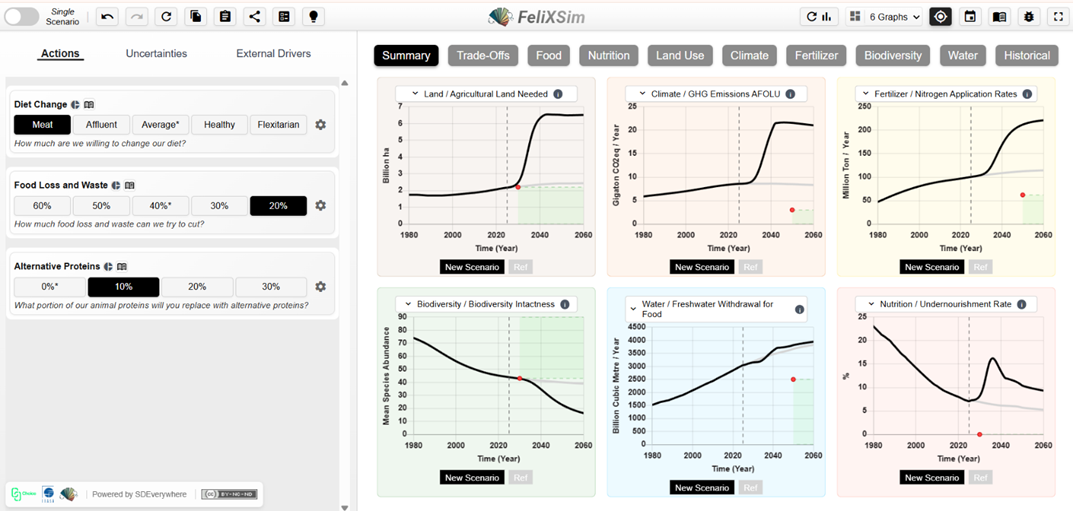
Figure 1. The FELIX ISE Nutrition dashboard showing dietary intake and undernourishment indicators under selected scenarios.
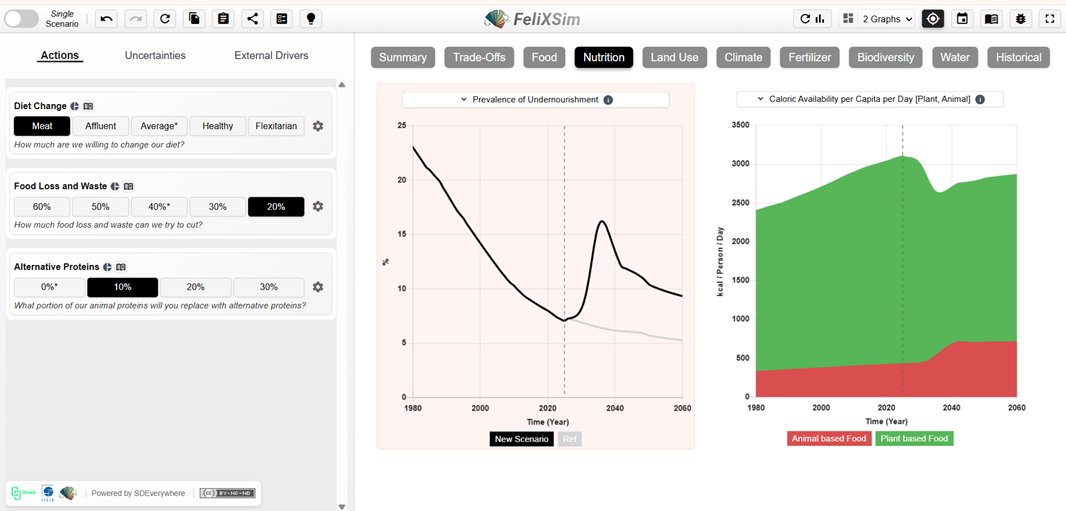
Figure 2. The FELIX ISE Summary dashboard under a modified behavioural scenario illustrating projected impacts on emissions, temperature, land use, and biodiversity.
Designed for Impact: The FELIX ISE within CHOICE
The FELIX ISE was not designed in isolation. It is a product of the CHOICE Horizon Europe project (Grant Agreement No. 101081617), which brings together a multidisciplinary consortium of partners across 3 continents to forge climate-conscious choices in the food system. Within CHOICE, the ISE serves a dual purpose: it is both a scientific tool for exploring behaviour-driven food demand scenarios and a communication instrument for engaging diverse audiences with the implications of their food choices.
The technical development of the ISE has been led by IIASA and ICCS, who collaboratively designed and implemented the web-based interface that makes the FeliX model outputs accessible to non-expert users. The underlying FeliX model is developed and maintained by IIASA supporting the mainstreaming of IAM modelling and the integration of behavioural change representations. This collaboration ensures that the ISE remains scientifically rigorous while being genuinely usable.
A key design principle has been co-design with stakeholders. The ISE’s interface and scenario structure have been shaped by feedback from internal CHOICE workshops, where partner organisations tested early prototypes and provided input on usability, visual clarity, and the relevance of output indicators. The first version was formally presented at an internal CHOICE workshop on 25 March 2025, marking a significant milestone in the transition from complex research model to accessible web-based tool.
Within the CHOICE project, the ISE is designed to support participatory labs and educational outreach activities across the project’s five pilot regions in Austria, Greece, Spain, Colombia, and South Africa. By allowing citizens and stakeholders to interact directly with scenario modelling, the ISE contributes to CHOICE’s mission of driving substantial behavioural and lifestyle changes in Agriculture, Food, and Land Use sectors.
Readiness for Use
Will it be tested with citizens, students, or policymakers?
The FELIX ISE is now a fully functional, openly accessible web application. Users can access it directly at climatechoice.github.io/felix — no installation, no registration, and no technical expertise required.
The ISE has already been showcased at the Scenarios Forum 2025, held at the University of Leeds in July 2025, where it was presented to an international audience of researchers and policymakers working on socioeconomic scenarios for sustainability. The positive reception at this event reinforced the value of making IAM outputs interactive and participatory. A dedicated article on the CHOICE website — Reimagining Climate Action with FELIX ISE — documented the insights gained from this engagement. FeliX ISE was also reviewed and tested in a dedicated expert workshop in January 2026, and used in a timely analysis of recent dietary guidelines by US Food and Drug Administration (FDA).
Looking ahead, the ISE is being prepared for deployment in “open for all” CHOICE’s related engagement activities scheduled to be taken place at the end of March 2026, where it will be tested with citizens, students, and policymakers in real-world participatory settings. These sessions will allow participants to explore how their collective food choices could contribute to limiting global temperature rise to 1.5°C, in line with the Paris Agreement targets.
Consistent with the CHOICE project’s commitment to open science, the FELIX ISE is fully open source. The complete source code is available on GitHub at github.com/climatechoice/felix, enabling other researchers, developers, and organisations to inspect, reuse, and build upon the work. The repository includes the application code, configuration files, model data, and documentation. The underlying FeliX model (version 26) is also openly available, with its codebase hosted on GitLab. This open approach contributes directly to the CHOICE project’s WP7 Key Performance Indicators on open-source tools and open datasets, and aligns with the broader Horizon Europe principles of transparency and reproducibility in publicly funded research.
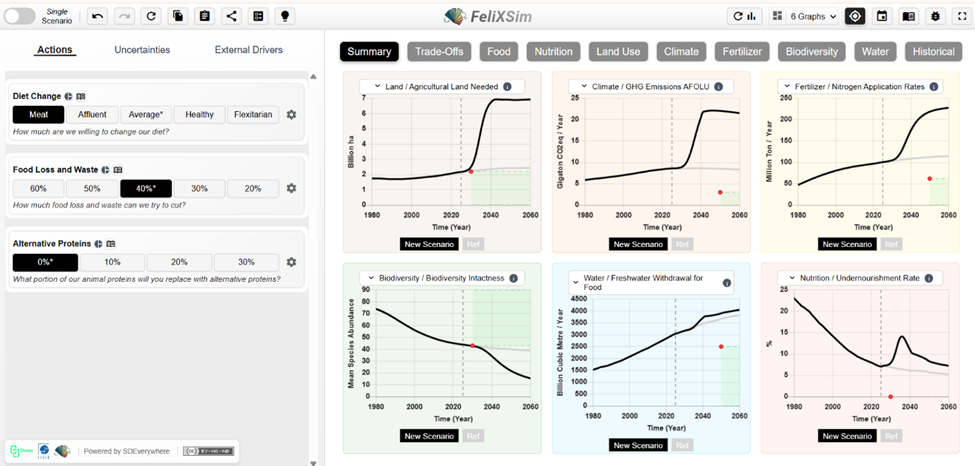
Figure 3. The FELIX ISE Summary dashboard under a reference scenario with lower food loss and waste reduction, serving as a comparison benchmark.
What's Next: Expanding Impact and Engagement
The development of the FELIX ISE is an ongoing process, with several milestones planned for the coming months:
- Interface refinement: Continued improvements to visual design, usability, and the clarity of output presentations based on user feedback from workshops and pilot activities.
- User testing with diverse audiences: Structured testing sessions with citizens, students, and policymakers across CHOICE pilot sites to evaluate the tool’s effectiveness in communicating complex system dynamics.
- Integration with CHOICE engagement campaigns: Deployment of the ISE as a core component of CHOICE’s large-scale awareness and nudging campaigns, alongside other digital tools such as the eco-labelling app, the “Shrink Your Food Waste” app, and the Climate Survivors game.
- Enhanced scenario capabilities: Expanding the range of behavioural inputs and output indicators to reflect the latest developments in the FeliX model, including regional analysis capabilities.
“The FELIX ISE is about more than making a model interactive. It is about creating a space where people can see the consequences of collective action. When a citizen adjusts a scenario slider and watches how reduced food waste could change emission trajectories over decades, that moment of insight can be more powerful than any report. Our goal is to turn complex science into a shared language for climate action.”
Dr. Nikolaos D. Tantaroudas, Senior Researcher at ICCS, CHOICE Project manager.
Why It Matters: Key Takeaways
- A tool for awareness, learning, and action: The FELIX ISE makes the complex dynamics of the global food–climate system accessible to non-expert audiences, supporting informed decision-making at every level.
- Bridging science and society: By translating the outputs of the FeliX Integrated Assessment Model into an intuitive visual interface, the ISE creates a shared space where researchers, policymakers, and citizens can collaborate on scenario development.
- Open source and reproducible: Fully available on GitHub, the FELIX ISE embodies the CHOICE project’s commitment to transparency, open science, and community-driven innovation.
- Preparing the ground for engagement and nudging: As CHOICE moves into its pilot engagement phase, the ISE will serve as a central tool for participatory labs, educational outreach, and large-scale behavioural campaigns across five pilot regions.