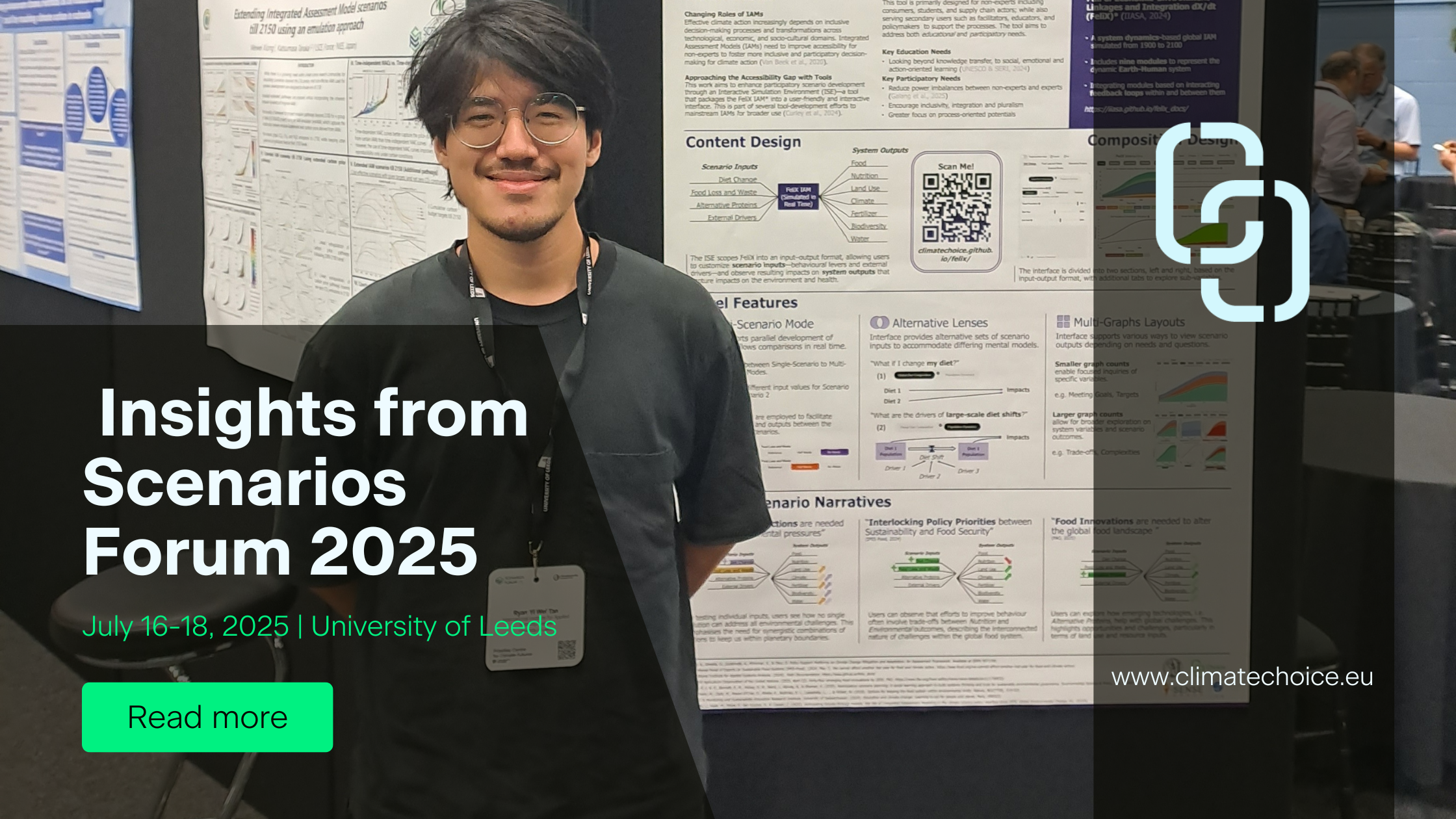
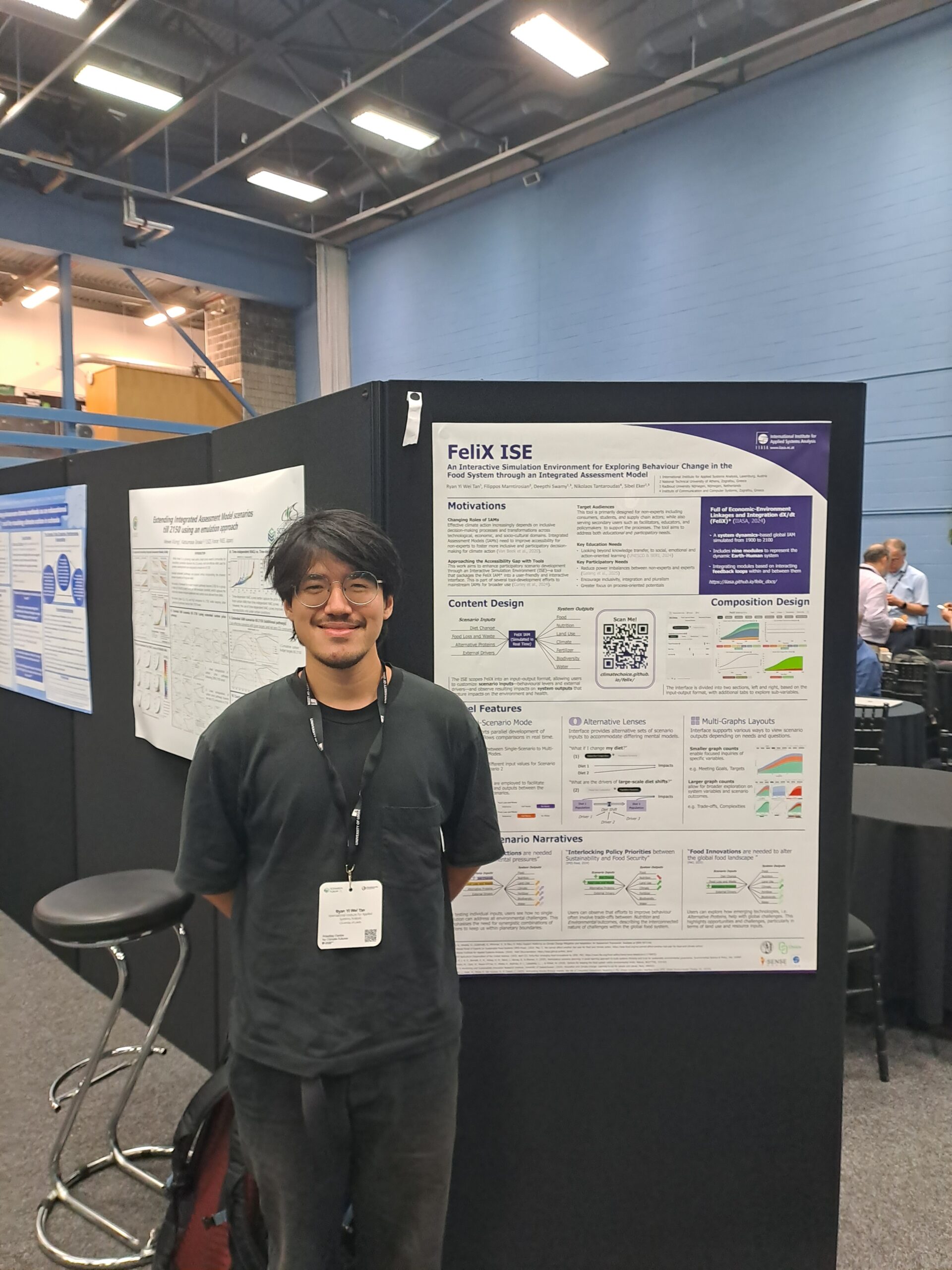
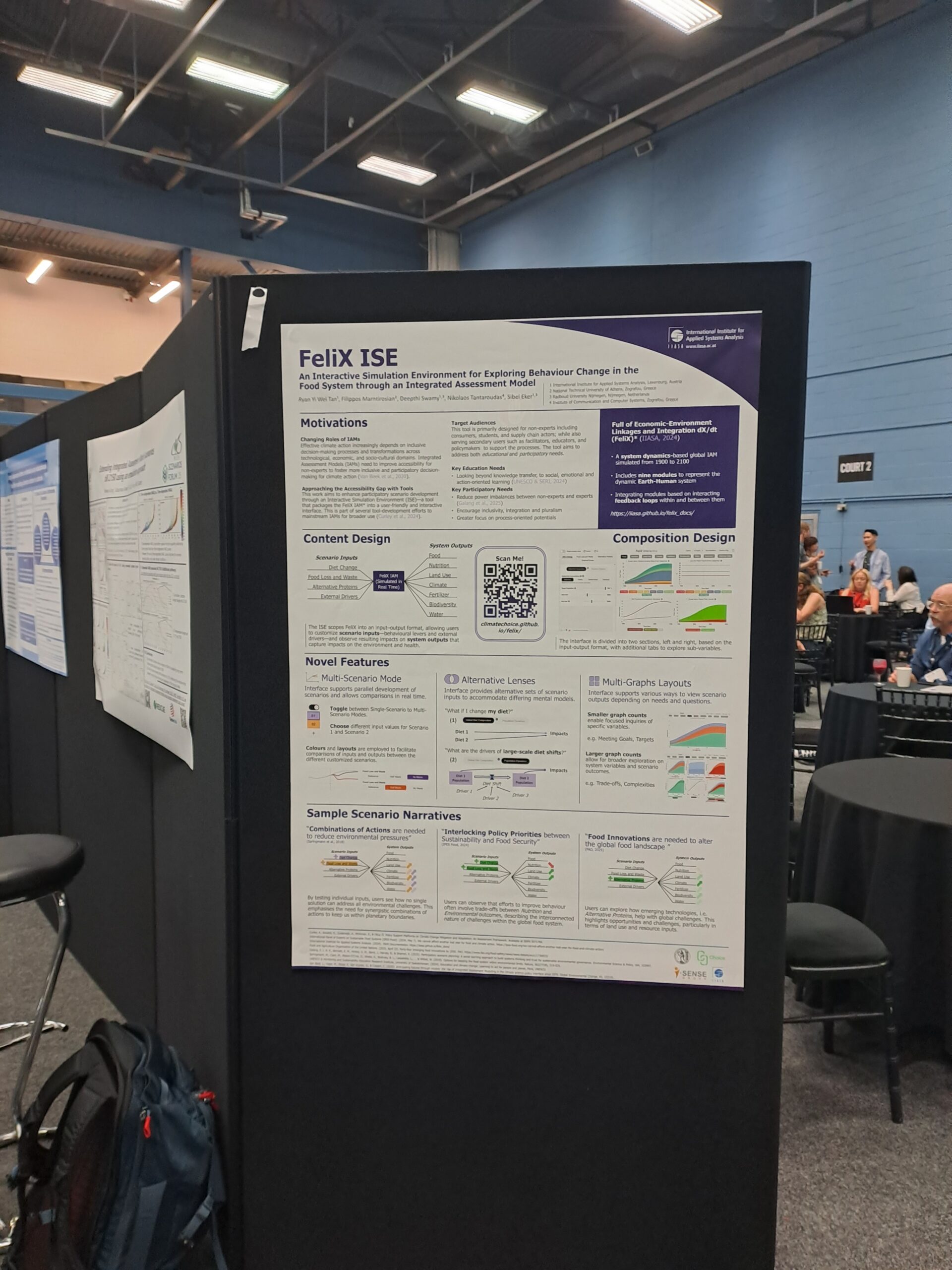
In mid-July 2025, Leeds welcomed the forward-thinking Scenarios Forum 2025, dedicated to exploring societal and climate futures through integrated assessment models (IAMs). On the evening of July 17, during the poster session in Sports Hall 1, Ryan Yi Wei Tan of IIASA presented the poster titled “FeliX ISE: An Interactive and Participatory Tool for Exploring Behaviour Change Scenarios in the Food System.” The work, integral to CHOICE’s Task 3.4, was co-authored by Filippos Marntirosian, Deepthi Swamy, Nikolaos Tantaroudas, and Sibel Eker, and was aimed at reaching an audience primarily of academics while also including facilitators, educators and NGOs.
What Is FeliX ISE?
FeliX Interactive Simulation Environment (FeliX ISE) builds upon the robust FeliX model, a global system dynamics-based Integrated Assessment Model (IAM) developed by IIASA, designed to simulate complex interactions among population, economy, energy, land, food, climate, biodiversity, and more.
FeliX is one of the very few models that explicitly model human behaviors in the human-earth system, considering dynamic interactions of socio-economic and environmental sectors. The model is calibrated with data from 1900 to 2020 and projects through to 2100.
In the CHOICE project, FeliX is extended to include a wider range of food demand scenarios driven by behavioral change.
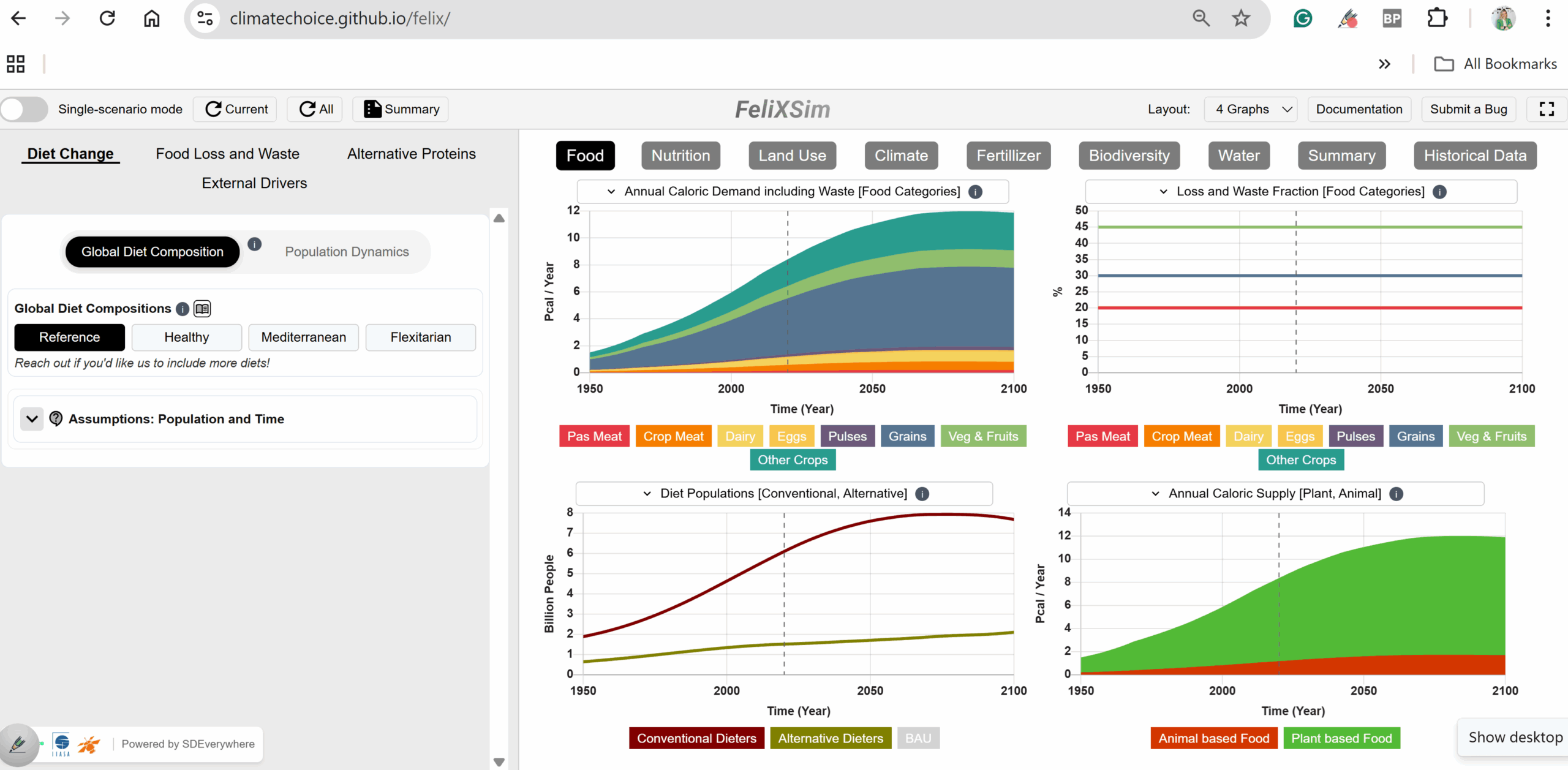
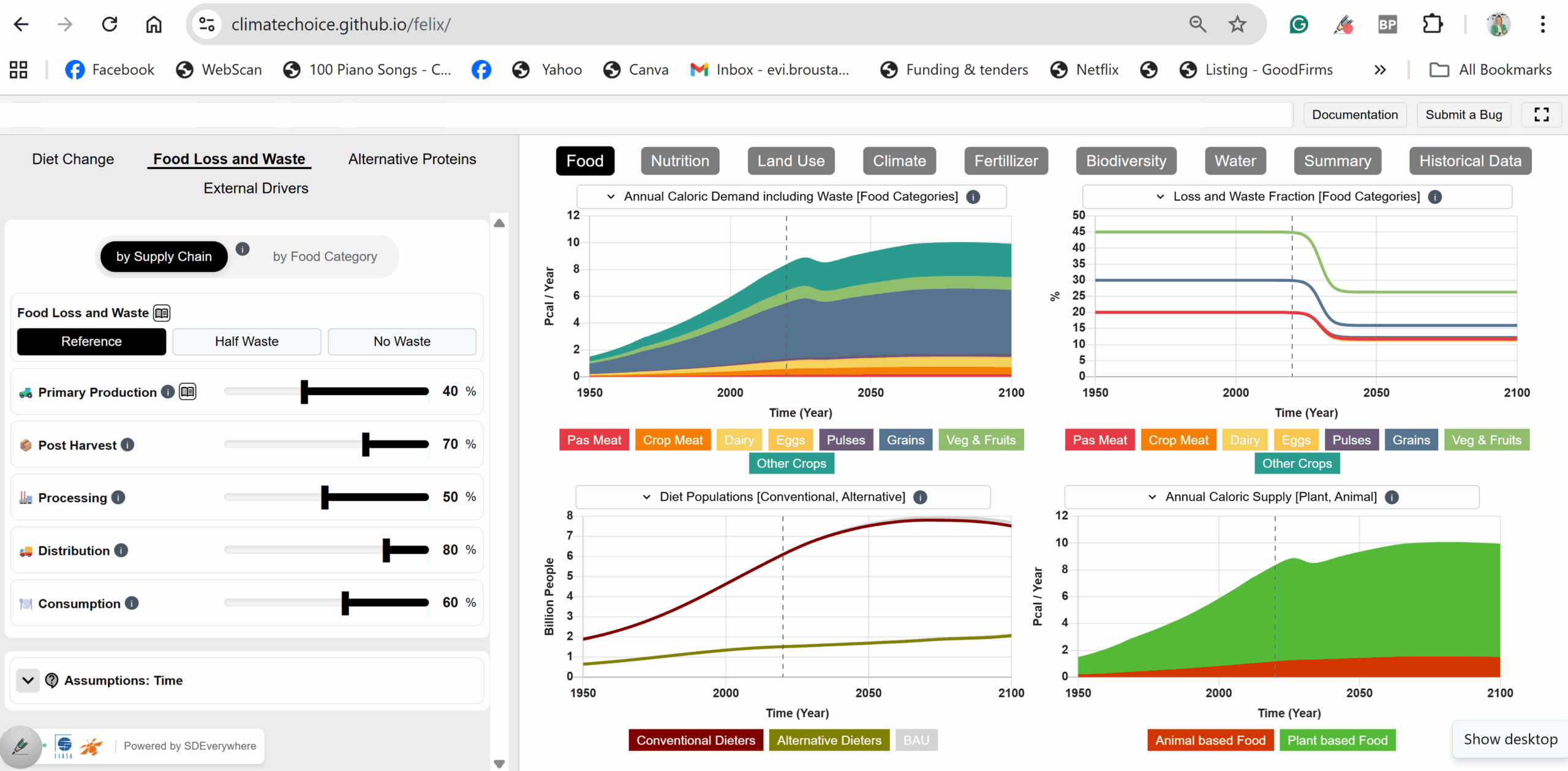
FeliX ISE goes beyond modeling by providing an online, interactive interface that targets non-experts users and enables them to explore behavior change scenarios in real time. The tool presents the opportunity to imagine adopting various food-related behaviors—such as dietary shifts, reducing food waste and loss, or embracing alternative proteins—and understand the resulting health and environmental outcomes from those behavioral changes.
IIASA leads in developing this ISE as a bridge between the FeliX model and the non-expert audiences through innovative forms of stakeholder engagement beyond traditional approaches. It supports participatory scenario development, enabling diverse actors, from policy advisors and educators to industry stakeholders, to co-produce plausible and inclusive pathways for sustainable development.
Significance in the CHOICE Project
FeliX ISE exemplifies CHOICE’s goal of integrating actor heterogeneity and behavioral science into IAMs, making models more relevant, participatory, and action-oriented.
By enabling exploration of diverse demand-side mitigation strategies, FeliX ISE contributes to improving transparency and stakeholder involvement. Its interactive nature supports learning, dialogue, and informed decision-making across scales—from classroom exercises to community workshops.
Highlights from the Conference Poster Session
The FeliX ISE poster was presented on Thursday, July 17, at 18:00, during the official poster session at Sports Hall 1 of the University of Leeds. The event brought together a multidisciplinary audience, including academic researchers, facilitators, educators and NGOs, working to advance socio-economic scenarios to solve the most complex and interconnected challenges in our times.
Ryan Tan’s presentation sparked strong interest from attendees, who engaged in thoughtful conversations around the tool’s potential to democratize access to integrated assessment models. Participants noted the clarity and responsiveness of the interface, its ability to accommodate diverse mental models, and its usefulness in fostering participatory dialogue. Many highlighted its relevance for teaching, policy design, and public engagement -particularly in sectors and contexts where behavior change is critical to mitigation efforts-. Attendees also provided meaningful suggestions on ways to improve the tool’s engagement, usefulness, and user experience.
Looking Ahead
As the CHOICE project moves forward, deploying FeliX ISE in pilot regions—Austria, Greece, Colombia, Spain, and South Africa—will be essential. The tool promises to enhance sustainable food system strategies by enabling scenario-based exploration of diet shifts, waste reduction, and adoption of alternative proteins with real-world relevance.
Whether visualizing the climate impact of dietary choices or engaging stakeholders in policy co-creation, FeliX ISE embodies CHOICE’s commitment to turning rigorous modelling into meaningful action.
Find the presented poster here and explore the initial version of FeliX ISE at the https://climatechoice.github.io/felix/ to understand how individual behaviour changes in the food system can influence a wide range of sustainable development outcomes, and stay tuned for more updates.