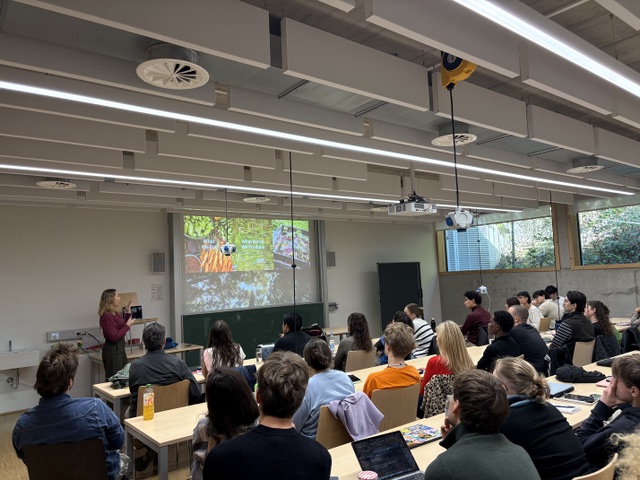
How can scientific models help shape the future of our food systems? On 16 October 2026, CHOICE expert Marta Kozicka from the International Institute for Applied Systems Analysis (IIASA) delivered an invited lecture at BOKU University in Vienna, Austria, introducing students to the role of Integrated Assessment Models (IAMs) in understanding the challenges and opportunities of sustainable food-system transformation.
The lecture brought together approximately 60 students participating in the interdisciplinary course Negotiating Change: Future of Food, who are preparing for a simulated United Nations summit on the future of food, scheduled to take place at the Vienna International Centre (VIC) in January 2027.
Exploring Sustainable Food Futures Through Integrated Assessment Modelling
At the heart of the lecture was IIASA’s Global Biosphere Management Model (GLOBIOM), a global economic land-use model that explores the complex interactions between agriculture, forestry, land use, food production and environmental sustainability.
Drawing on GLOBIOM-based scenario analysis, Marta introduced students to potential pathways towards more sustainable food systems, focusing on three key transformations:
Shifting towards healthier and more sustainable diets, aligned with the EAT–Lancet Planetary Health Diet.
Replacing 50% of animal-based products with novel plant-based alternatives, exploring the implications of changing dietary preferences.
Halving food loss and waste, examining how more efficient food systems could reduce environmental pressures.
These scenarios helped illustrate how changes in food consumption patterns can interact with agricultural production, land use and broader economic dynamics, highlighting the importance of considering both demand-side behavioural changes and supply-side transformations.
Understanding the Trade-offs Behind Food-System Transformation
A central message of the lecture was that transitioning towards sustainable food systems requires more than identifying environmentally beneficial solutions. It also involves understanding their economic and social implications.
Through GLOBIOM-based insights, students explored projected changes in agricultural production value across sectors, alongside potential implications for food affordability and employment.
The discussion also addressed potential rebound effects, where the benefits of an intervention may be partially offset by other changes in the food system, as well as spillover effects extending across sectors and regions.
Recognising regional differences and the diverse circumstances of consumers, producers and other actors is essential for designing effective and inclusive food-system policies.
This perspective closely aligns with the CHOICE project’s mission to advance integrated assessment modelling by incorporating behavioural change and actor heterogeneity, supporting climate-conscious decisions while accounting for their wider socioeconomic impacts.
Connecting Scientific Evidence with Future Decision-Makers
Beyond presenting modelling approaches, the lecture offered students an opportunity to connect scientific evidence with real-world policy challenges.
As they prepare to represent different perspectives during their simulated UN negotiations, participants gained insights into the complex trade-offs that policymakers must consider when balancing climate mitigation, food security, economic development and social equity.
The session generated strong student engagement, with participants finding the GLOBIOM-based insights particularly valuable for developing their negotiation positions.
Building on this exchange, Marta has also been invited to participate in the final negotiation event at the Vienna International Centre in January 2027, creating a further opportunity to connect scientific research with the next generation of decision-makers.
Advancing CHOICE’s Mission Through Knowledge Sharing
By bringing advanced modelling insights into an interdisciplinary educational setting, the lecture demonstrated how scientific tools can support informed discussions about sustainable diets, agricultural transformation and climate action.
Through activities such as this, CHOICE contributes to bridging the gap between scientific research and societal decision-making, encouraging future professionals and policymakers to approach food-system transformation with a deeper understanding of its environmental, economic and social dimensions.
Building sustainable food systems is not only about understanding what needs to change, but also who is affected, how different choices interact and how we can move forward together.