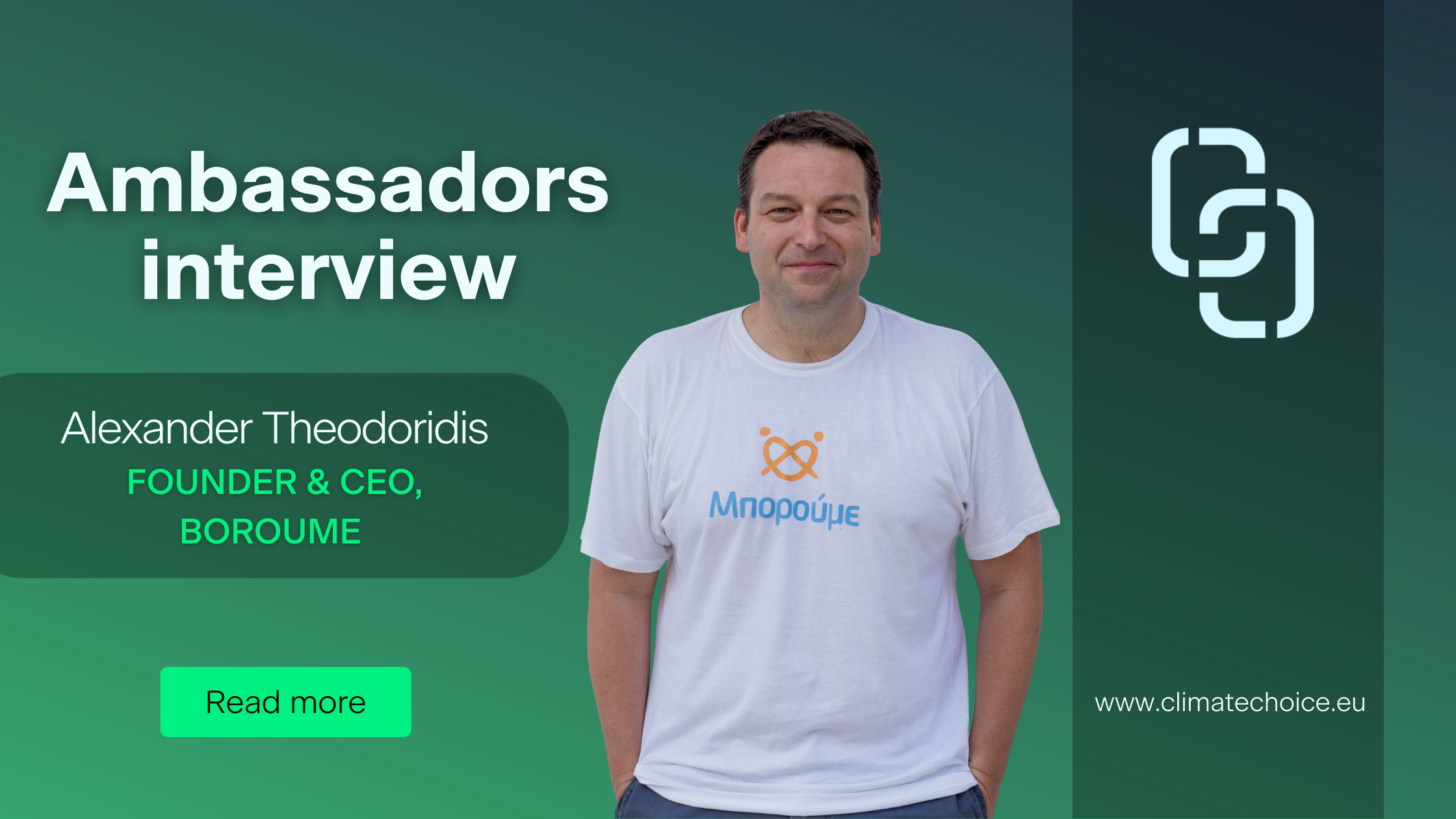
Ambassador Interview Series – Alexander Theodoridis
Every choice we make around food—what we buy, cook, share, or throw away—has the power to shape our climate future. Through the CHOICE project, we explore how everyday behaviours can unlock more sustainable, healthy, and inclusive food systems .
As part of our Ambassador Interview Series, we spotlight the people driving this change on the ground. In this conversation, Alexander Theodoridis, leading Boroume, reflects on more than a decade of tackling food waste in Greece—sharing insights on consumer behaviour, cultural values, and the small, everyday choices that can lead to lasting impact
1. You have been leading Boroume for more than a decade, saving over 120 million portions of food. What have you learned about consumer behaviour in Greece when it comes to food waste and food choices?
When Boroume started in 2011, food waste was hardly discussed in Greece. Since then, a lot has changed. Today, both large companies and consumers are much more aware of the issue, and we see a positive trend in terms of awareness and engagement.
Research on consumer behaviour shows that there are different approaches to encouraging people to reduce food waste. One approach is sentimental – appealing to people’s concern for the planet and for future generations. Another is economic – highlighting that wasting food also means wasting money. This has become particularly relevant in the last two to three years due to inflation and rising food prices, which has made consumers more conscious about how much they buy and waste. There is also a more rational approach, where people understand that reducing food waste simply makes sense both economically and environmentally.
When it comes to climate-friendly and healthier food choices, Greece is still below the EU average. However, there is a strong cultural willingness to share food and avoid wasting it. In many Balkan and Mediterranean cultures, if people cook more than they need, they will often share it with neighbours, friends or colleagues. This habit, especially common in smaller communities, helps prevent food from being wasted.
2. In your experience, is food waste primarily a behavioural issue, a systemic issue, or a combination of both? Where do you see the biggest leverage point for change?
Food waste is a multifaceted issue with many layers, so it is clearly a combination of behavioural and systemic factors. Over the past decade, some of the most visible progress has happened at the systemic level. Food companies, supermarkets and bakeries have increasingly started to reduce waste primarily for economic reasons – reducing waste means reducing losses and improving efficiency. Environmental considerations are also becoming more present, but the economic incentive has been the main driver of change.
At the same time, consumer awareness plays an important role. When people care more about food waste, they also put more pressure on companies and institutions to act. Compared to fifteen years ago, the topic is now much more present in public discussions and policy agendas. Organisations like Boroume have been part of this shift, helping to bring food waste into the spotlight.
However, in the long term, behavioural change remains the biggest leverage point. Consumers are the main actors in the food system, and the largest share of food waste still occurs at the household level. Changing behaviour takes time. Cultural habits related to food – especially in countries like Greece, Italy, Spain or across the Balkans – have developed over centuries and cannot change overnight.
Awareness-raising campaigns can help, but their effects are often temporary if they are not sustained. For example, Spain once ran a large national campaign that significantly reduced food waste while it was active, but once the campaign ended, the positive impact gradually disappeared. This shows how important continuous awareness-raising and education are. NGOs have played a key role in this process, helping to inform citizens and gradually build a culture where wasting food becomes less acceptable.
3. The Greek CHOICE pilot focuses on influencing food choices through the e-fresh online supermarket. How powerful do you think digital environments are in shaping consumer decisions?
Digital environments are becoming increasingly important in shaping consumer decisions, especially because we live in a highly digitalised world. Online tools and digital campaigns can play a significant role in raising awareness and influencing choices. However, their impact is strongest when messages reach consumers repeatedly and through different channels – not only online, but also through traditional media such as newspapers or television. Seeing the same message from different perspectives helps reinforce behavioural change.
At the same time, although the number of people using online supermarkets is growing, it still represents a relatively small share of overall food shopping. The majority of consumers still prefer to visit physical supermarkets. This means that digital environments should be seen as an important complementary tool rather than the only channel for influencing food choices.
One of the most effective ways to influence consumer behaviour, both online and offline, is through economic incentives. If supermarkets offer price advantages or promotions for climate-friendly products, many consumers will respond and adjust their purchasing decisions accordingly.
We also see how broader social changes influence the way food is sold and consumed. For example, households today are often smaller than they were in the past. As a result, supermarkets have adapted their offer to consumer demand – instead of selling only whole products, they may also offer smaller portions, such as a single slice of watermelon. These kinds of adjustments reflect how retailers respond to changing consumption patterns, which in turn influence food waste and purchasing behaviour.
4. Boroume strongly promotes volunteering and social giving. How important are social norms and collective values in accelerating sustainable food choices?
Social norms and collective values play an important role in accelerating sustainable food choices. Attitudes towards volunteering, sharing food and avoiding waste are strongly influenced by culture, and in some societies these practices are more deeply rooted than in others.
One of the most effective ways to strengthen these values is through education from an early age. At Boroume, we work with children in kindergartens, primary schools and high schools, raising awareness about food waste and solidarity. If these ideas are introduced early, they can shape long-term behaviour.
We already see how strongly companies influence children from a young age through branding and marketing. In a similar way, social norms such as volunteering and responsible food consumption can also be cultivated early in life and gradually become part of everyday behaviour.
5. Boroume works closely with businesses and local partners. How can retailers and online supermarkets become active allies in helping communities make more sustainable food choices?
Retailers and supermarkets can play a very important role in helping communities make more sustainable food choices. In fact, supermarkets are already among the largest food donors and often act as a focal point within neighbourhoods, as they are in daily contact with consumers. Because of this close relationship, they are in a strong position to influence purchasing and consumption habits.
Many supermarkets are already quite active in this area. Through newsletters and in-store communication, they can provide practical information that helps consumers reduce food waste. For example, Chalkiadakis, supermarket in Greece, inform customers through mobile app about the expiration dates of the products they have purchased, send recipe suggestions based on ingredients people may have left at home, and remind them when a product is approaching its expiry date.
Companies often begin these initiatives for economic reasons or to strengthen their public image, but many of them are becoming frontrunners in promoting more responsible consumption. At the same time, changing consumer behaviour requires more than technical solutions – it also needs to be connected with values such as respecting food and avoiding waste. This is something organisations like Boroume try to communicate by bringing the issue closer to people’s everyday lives and helping them understand the personal and societal benefits of reducing food waste.
Collaboration across sectors is also crucial. Boroume has been part of the national “Alliance for the Reduction of Food Waste”, which brings together companies, academia, NGOs and the Ministry of Environment. Within this initiative, Boroume developed awareness campaigns and communication materials that were shared across the alliance’s network. Because many actors from different sectors were involved, the impact of these messages was significant.
6. If you could change one thing tomorrow in the way Greek consumers purchase food, what would it be — and why?
If I could change one thing in the way Greek consumers purchase food, it would be to encourage more rational and organised shopping habits. A simple step such as making a shopping list can significantly reduce food waste. It is difficult to plan exactly what we will eat two weeks in advance, but better short-term planning and more frequent shopping can make a big difference.
Online supermarkets can help in this process, as they make it easier for consumers to organise their purchases and buy only what they actually need. Prices online are often similar to those in physical stores, but the digital environment allows people to think more carefully about what they add to their basket.
Another important aspect is learning how to use leftovers and making better use of the food that is already at home. When people understand that food waste can cost a household between 500 and 1,000 euros per year, this becomes a strong motivation to change behaviour. While environmental concerns matter to some consumers, economic reasons are often the strongest driver for change.
7. How does your work with Boroume align with the objectives of the CHOICE project in mainstreaming behavioural change in food systems?
Over the years, Boroume has invested significant effort in awareness-raising and education in Greece, especially among younger generations.
Through our educational programmes, we have reached around 130,000 children and young people aged 4 to 18, helping them understand the importance of reducing food waste and valuing food. Thousands of students have also participated in volunteering activities, collecting surplus food from supermarkets and helping redistribute it to people in need.
Many of these children are now young adults making their own consumption choices. If values related to food preservation and waste reduction are introduced early in life, they often become part of everyday behaviour later on. This long-term approach to behavioural change is very much in line with what the CHOICE project aims to achieve.