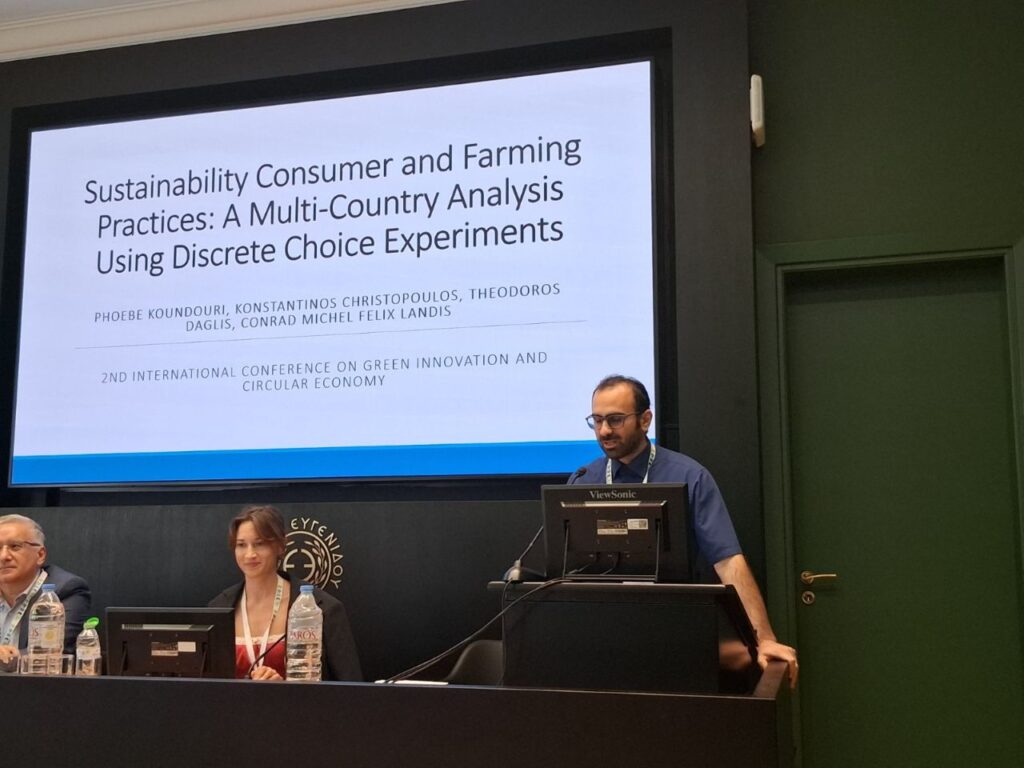
On 12 May 2026, the ATHENA Research Center team participated in the 2nd International Conference on Green Innovation and Circular Economy (GR-I-CE 2026) in Athens, Greece.
Representing CHOICE’s work on behavioural insights and sustainable food systems, ATHENA presented the study “Sustainability Consumer and Farming Practices: A Multi-Country Analysis Using Discrete Choice Experiments.”
What Drives Sustainable Decisions?
The presentation explored a central question for climate action: what makes people and producers choose more sustainable options?
To answer this, the study used Discrete Choice Experiments (DCEs), a method that asks participants to choose between hypothetical alternatives with different characteristics. This helps researchers understand which factors matter most when people make decisions — from price and nutrition to environmental impact, water use and economic incentives.
Within CHOICE, DCEs are used to examine both consumer choices and producer decision-making across different agri-food systems, helping to reveal the trade-offs behind more sustainable food and farming practices.
Four Case Studies, One Shared Challenge
The study presented four CHOICE pilot applications across diverse food and farming contexts.
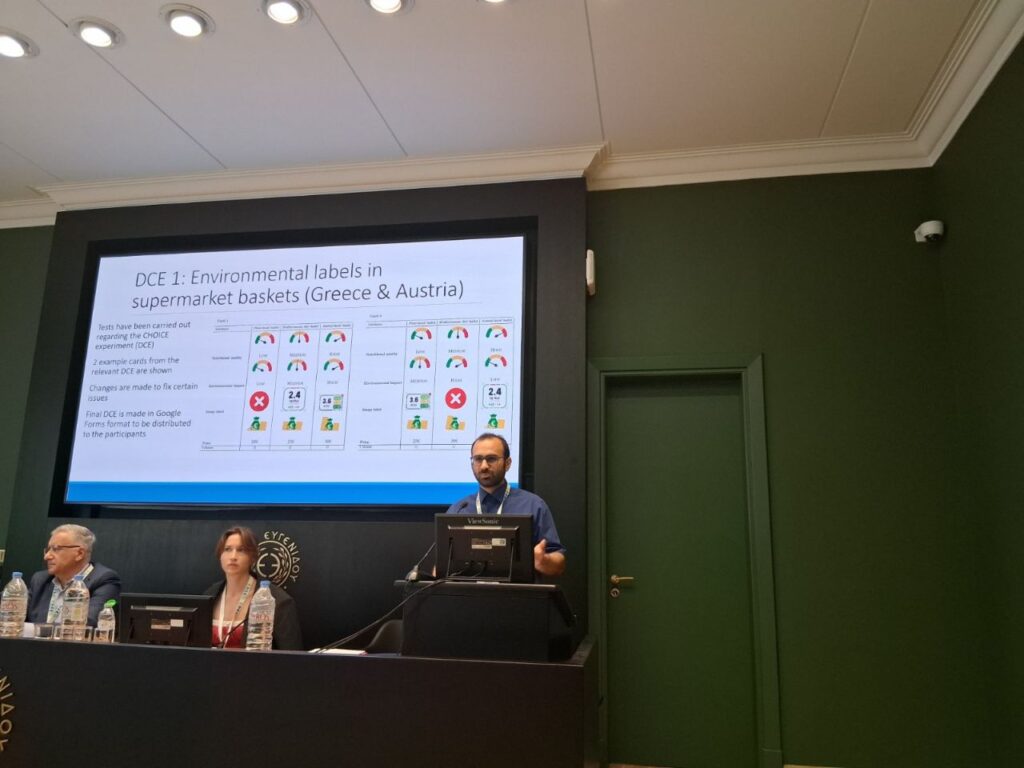
In Greece and Austria, the research looked at how consumers value environmental labels in supermarket baskets, while keeping the macronutrient composition of the baskets constant. The baskets were labelled as plant-based, Mediterranean diet and animal-based.
In South Africa, the focus was on suboptimal produce and food waste, measuring consumers’ willingness to purchase imperfect produce to help reduce retail food waste and related CO₂ emissions.
In Andalusia, the study examined sustainable olive farming, evaluating willingness to adopt climate-resilient agricultural practices in water-scarce regions.
In Colombia, the research addressed sustainable coffee production, focusing on the adoption of water-saving and environmentally sustainable practices, including agroforestry, improved fermentation procedures and fixed monetary support for transition.
Turning Behavioural Insights into Better Sustainability Pathways
Together, these four applications offer a structured way to understand how consumers and producers balance economic, environmental and nutritional factors in real-world agri-food contexts.
As highlighted in the presentation, the work is still in progress and the insights remain preliminary. At this stage, the DCEs are helping validate the selected attributes and refine the survey instruments for the next phases of implementation and analysis.
Why It Matters for CHOICE
ATHENA’s contribution at GR-I-CE 2026 showcased how behavioural research can strengthen sustainability policy and climate action.
By exploring how people respond to different sustainability options across countries and contexts, this work supports CHOICE’s wider mission to develop more evidence-based, inclusive and practical pathways for sustainable food systems, climate-resilient agriculture and circular economy transitions.
The presentation delivered by the ATHENA Research Center team at GR-I-CE 2026 is available here.



Leave a Reply